Tell us what you are seeing
Share the main issue, the property city, and the best way to reach you.
Ventilation guidance
For many Gastonia homes, the answer to that question has changed over the years. Learn what modern crawl space practice recommends and why.
Disclosure: Gastonia Crawl Space Repair Help is an independent service that helps connect homeowners with local crawl space professionals. We do not perform contractor services ourselves. Your request may be shared with a local provider who can assist with your project.
Homeowner request path
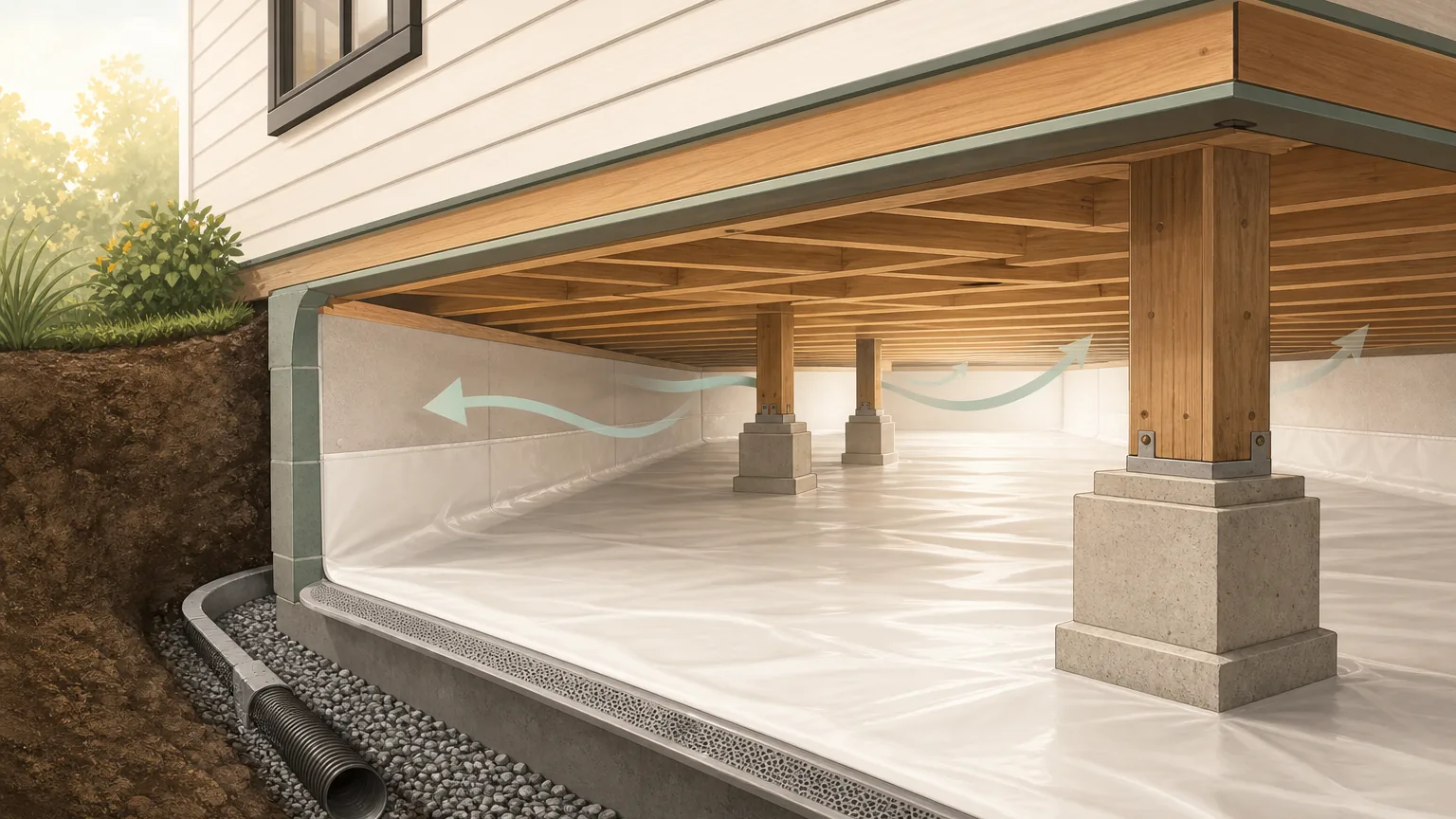
Gastonia, NCA conventionally vented crawl space uses outdoor-air openings as part of its design. A closed crawl space follows a different path involving ground and wall moisture control, air-sealing details, insulation decisions, mechanical or humidity control, and permits. Humid summer air can condense on cooler crawl-space surfaces, so a seasonal open-or-closed rule can miss the building system around the vents.
Closing crawl space vents typically means installing covers or plates that seal the openings. If you are already planning encapsulation, this step is usually included as part of the work. For homes without a vapor barrier, simply closing vents without addressing the underlying moisture source can trap dampness and create new problems inside the crawl space.
The permit path for changing conventional crawl-space venting to closed construction comes from Section R409 of the 2018 North Carolina Residential Code, as cited by North Carolina Office of State Fire Marshal guidance dated December 11, 2025. Its five moisture-control methods are a permanently installed dehumidifier, supply air, house air moved by a fan, exhaust, and a designed conditioned space. Confirm current code, permit, inspection, and trade requirements with Gaston County.
Before changing vents, identify fuel-burning equipment, ducts, air handlers, condensate drains, plumbing, wiring, and insulation. Combustion air and safety may require qualified design. The insulation location and fire-protection details can also change between vented and closed approaches.
Some openings may serve floodplain requirements and should not be treated as ordinary vents without local review. Liner and wall work should preserve required termite inspection visibility and access for future pest evaluation.
Radon cannot be predicted by odor, moisture, or appearance. Homeowners may discuss testing before and after enclosure changes using current EPA radon guidance.
Some conventionally vented crawl spaces remain open while the homeowner evaluates ground coverage, drainage, and a complete moisture plan. Closing vents by itself can trap an existing damp condition. A crawl space inspection can clarify what is in place and whether the vents belong in a broader vapor-barrier or encapsulation scope.
Cost depends on the number and condition of vents, access, cover or sealing method, current vapor-barrier coverage, moisture or drainage problems, access-door work, and whether humidity control or full encapsulation belongs in the same scope.
Request help sooner when water enters through low vents, condensation is heavy, insulation stays wet, odors move upstairs, or wood and floor symptoms are getting worse. Water near wiring or mechanical equipment requires a safe-distance response rather than crawl-space entry.
Share the main issue, the property city, and the best way to reach you.
We route the request so a local crawl space provider can follow up when available.
The provider can discuss inspection timing, repair options, and pricing factors.
Related help includes crawl space encapsulation in Gastonia, moisture control, vapor barrier work, and mold and musty odor concerns.
Helpful homeowner guidance
Vent treatment connects to moisture control, mechanical work, insulation, drainage, monitoring, and permits.
Sources: NC closed crawl-space permit interpretation, NC moisture-control and licensure interpretation, Department of Energy crawl-space guide
Disclosure: Gastonia Crawl Space Repair Help is an independent service that helps connect homeowners with local crawl space professionals. We do not perform contractor services ourselves. Your request may be shared with a local provider who can assist with your project.
Season alone does not settle the design. A conventionally vented crawl space and a permitted closed crawl space use different moisture, insulation, air, and mechanical strategies. Review the whole system before changing vents.
For a conventionally vented crawl space, changing to closed construction requires a permit under the cited code pathway. The North Carolina Office of State Fire Marshal issued that guidance on December 11, 2025.
North Carolina guidance recognizes several moisture-control paths for a closed crawl space. A dehumidifier is one path. Confirm the permitted design, responsible trades, condensate or air route, and monitoring method for the actual home.
Combustion safety and required air should be evaluated before changing the enclosure. Ask the appropriate licensed professional and permit authority to review the actual equipment.
No. Flood openings can serve a separate floodplain function. Do not block or alter them without confirming the property requirements with the local floodplain and permit authorities.