Tell us what you are seeing
Share the main issue, the property city, and the best way to reach you.
Closed crawl-space planning
Encapsulation can help manage ground moisture and humidity when paired with the right drainage and ventilation plan.
Disclosure: Gastonia Crawl Space Repair Help is an independent service that helps connect homeowners with local crawl space professionals. We do not perform contractor services ourselves. Your request may be shared with a local provider who can assist with your project.
Homeowner request path
Gastonia, NCQuick answer: Encapsulation works as a sequence: control bulk water first, seal the crawl space second, then condition and monitor the air. Full systems commonly run $5,000 to $15,000, or about $3 to $10 per square foot. Share whether water appears after rain, the condition of the current liner, and any humidity readings to request local contact.
Encapsulation seals and manages the crawl-space enclosure. A vapor barrier mainly covers soil to limit ground vapor, while waterproofing controls liquid water from entry through collection and discharge. One scope does not automatically replace the others.
Encapsulation often comes up when a crawl space stays damp, smells musty, has exposed soil, or has a loose vapor barrier that no longer covers the ground well.
Gastonia crawl space encapsulation is usually a fit when exposed soil, torn liner, humid air, or damp insulation keeps coming back. If standing water appears after rain, review crawl space waterproofing for bulk-water control before sealing the crawl space.
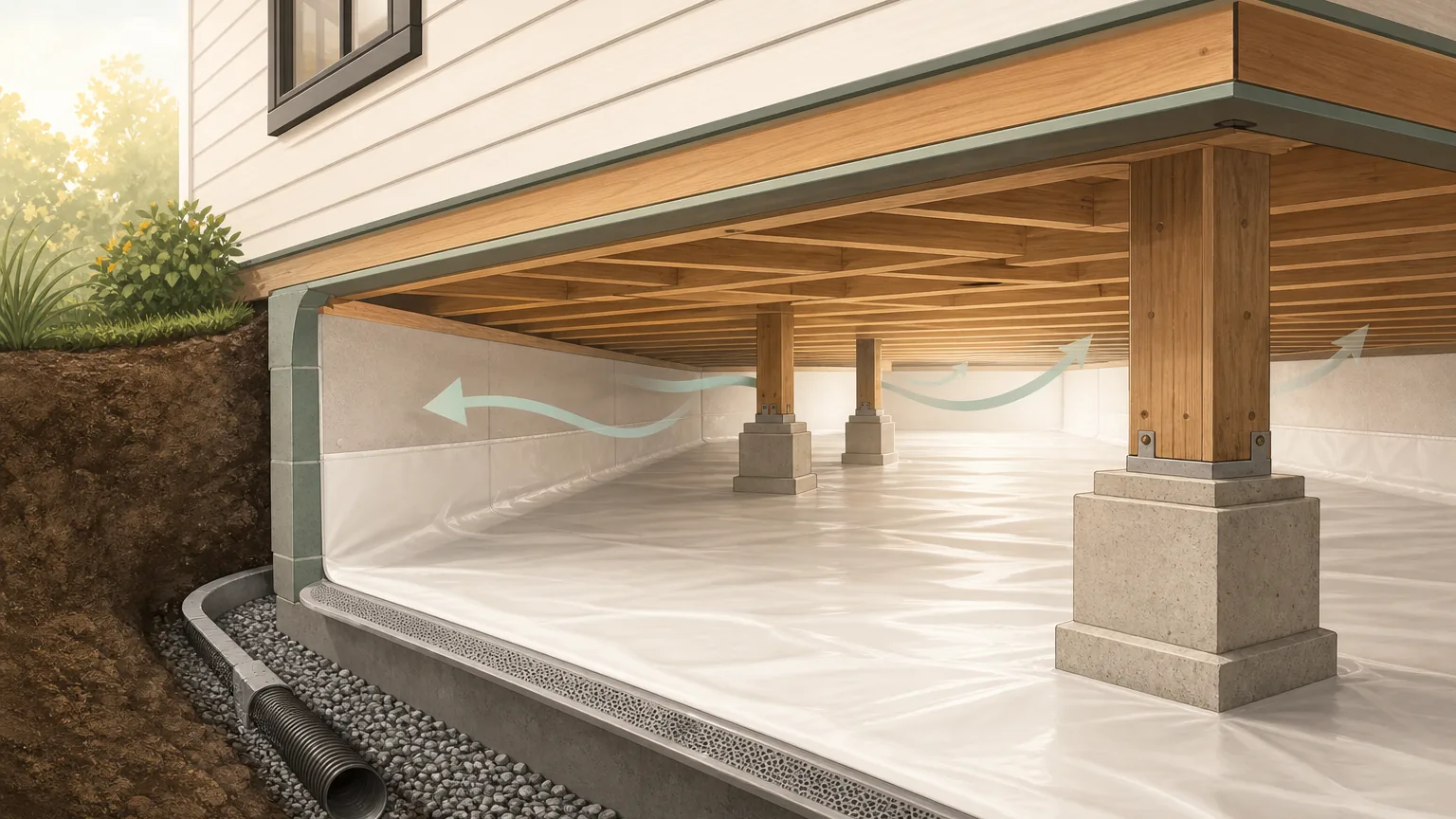
A full system uses reinforced liner across the floor and up the foundation walls. Installers overlap and tape the seams, fit the material around piers and penetrations, mechanically fasten the wall liner, and seal its top edge. Reinforced 12-mil to 20-mil liner is typical for encapsulation because it handles seams, wall coverage, and service traffic better than basic 6-mil ground cover.
Ask the provider to document active plumbing and condensate leaks, roof runoff, grading, foundation entry, groundwater, drains, sump equipment, debris, pests, unsafe wiring, fuel-burning equipment, insulation, and visible framing concerns. A closed system needs a water-management plan and safe mechanical conditions.
North Carolina Office of State Fire Marshal guidance dated December 11, 2025 ties the permit requirement for converting a conventionally vented crawl space to a closed crawl space to Section R409 of the 2018 North Carolina Residential Code. That pathway includes a moisture-control method such as a permanently installed dehumidifier, supply air, house air moved by a fan, exhaust, or a designed conditioned space. Confirm current permit, inspection, and trade-license requirements with Gaston County.
A basic vapor barrier covers the soil with ground-cover material, often 6-mil polyethylene, while vents and the rest of the crawl space may remain open. Encapsulation uses reinforced 12-mil to 20-mil liner on the floor and walls, sealed vents and access, and active humidity control. The side-by-side comparison explains when each scope is enough.
Standing water, damaged wood, failing supports, or active drainage problems may need repair before sealing the crawl space. Sealing a wet problem before fixing the water source can trap moisture and shorten the life of the work.
Encapsulation owns the sealed enclosure and conditioned air after active water is controlled. Waterproofing plans the full water path, while drainage supplies the collection and evacuation hardware. Repair and insulation removal address damaged materials before the liner closes the space.
Full encapsulation commonly runs $5,000 to $15,000, or about $3 to $10 per square foot. An installed crawl-space dehumidifier commonly runs $1,000 to $3,000. Crawl space size, height, cleanup, 12-mil versus 20-mil liner, wall coverage, seam work, access treatment, drainage, electrical work, and insulation removal determine where the project falls within those ranges.
Ask whether fuel-burning equipment is present, how combustion safety will be evaluated, and whether ducts or air handlers need repair before the enclosure changes. Preserve any required termite inspection gap. Radon cannot be judged from appearance, so homeowners may discuss testing before and after enclosure changes using current EPA radon guidance.
The final walkthrough should identify the humidity monitor, condensate outlet, sump and alarm tests, liner traffic protection, drains, access door, equipment manuals, filter schedule, and a plan for checking new water entry. The encapsulation maintenance guide organizes those follow-up checks.
Share the main issue, the property city, and the best way to reach you.
We route the request so a local crawl space provider can follow up when available.
The provider can discuss inspection timing, repair options, and pricing factors.
Related help: crawl space repair, crawl space waterproofing, standing water and drainage, vapor barrier work, moisture control, and cost factors.
Helpful homeowner guidance
Official state and federal guidance treats crawl-space closure as a coordinated building, water, mechanical, air-sealing, insulation, and monitoring project.
Sources: NC closed crawl-space permit interpretation, NC moisture-control and licensure interpretation, Department of Energy crawl-space guide
Disclosure: Gastonia Crawl Space Repair Help is an independent service that helps connect homeowners with local crawl space professionals. We do not perform contractor services ourselves. Your request may be shared with a local provider who can assist with your project.
Encapsulation request
Use this request when the crawl space has exposed soil, loose liner, musty air, damp insulation, or humidity that may need a fuller sealing plan. Mention whether water is standing after rain, because drainage may need review before encapsulation.
North Carolina Office of State Fire Marshal guidance dated December 11, 2025 says a permit is required when a conventional vented crawl space is converted to a closed crawl space. Confirm current requirements with Gaston County before work starts.
The scope should address active leaks, recurring stormwater, drainage, standing water, unsafe wiring, combustion concerns, pests, debris, damaged materials, and structural problems before the crawl space is closed.
It should describe ground and wall coverage, seams, piers, penetrations, vents, access doors, drains, sump lids, termite inspection gaps, insulation, humidity control, condensate routing, electrical work, permits, monitoring, maintenance, and exclusions.
North Carolina guidance recognizes several moisture-control paths for a closed crawl space. Ask who designed the approach, who installs it, how moisture leaves the space, and how humidity will be monitored.
Full encapsulation commonly runs $5,000 to $15,000, or about $3 to $10 per square foot. An installed crawl-space dehumidifier may add $1,000 to $3,000 when it is outside the base scope. Drainage, cleanup, insulation removal, electrical work, and structural repair can change the final total.
Radon levels cannot be predicted from appearance. Homeowners can discuss testing before and after enclosure changes with a qualified professional and follow current Environmental Protection Agency guidance.
Typical follow-up includes checking humidity readings, liner seams and traffic areas, drains, sump equipment, alarms, condensate lines, dehumidifier filters, pests, and any new water entry.