Encapsulation decision help
Should I Encapsulate My Crawl Space? A Guide for Gastonia, NC Homeowners
Encapsulation can help when moisture, odors, or insulation problems keep returning no matter what you try. Learn what factors usually drive the decision for Gastonia homeowners.
Disclosure: Gastonia Crawl Space Repair Help is an independent service that helps connect homeowners with local crawl space professionals. We do not perform contractor services ourselves. Your request may be shared with a local provider who can assist with your project.
Homeowner request path
Gastonia, NC- Share the crawl space issue you are seeing.
- Choose repair, encapsulation, moisture, drainage, or support help.
- Get connected with a local provider when available.
How to know if encapsulation makes sense for your home
Encapsulation may be worth considering when repeated moisture problems keep showing up even after basic fixes, when musty smells push into living spaces from below, or when insulation stays damp and loses its effectiveness over time. If you have had to remove wet insulation multiple times or notice wood surface moisture that does not dry out between rains, those are signals worth discussing with a provider who serves the Gastonia area.
A provider can check the current vapor barrier, measured humidity, ventilation setup, drainage, mechanical systems, insulation, pests, and water history before recommending a direction. Do not treat crawl-space storage, health outcomes, energy savings, or floor correction as guaranteed results.
Decision sequence
- Handle hazards and active leaks. Address electricity, sewage, fuel-burning equipment, plumbing, condensate, pests, and structural movement.
- Control bulk water. Review gutters, downspouts, grade, foundation entry, groundwater, drains, sump equipment, and discharge.
- Measure humidity and inspect materials. Record trends and document liner, insulation, framing, ducts, and access.
- Compare targeted corrections with full closure. Ask what each option includes, excludes, and requires for permits and maintenance.
- Plan verification. Define humidity monitoring, drainage tests, equipment service, liner inspection, and follow-up.
Reasons to pause the decision
Pause when the water source remains unclear, standing water continues, fuel-burning equipment has not been evaluated, structural or pest damage lacks a plan, the estimate omits permits or humidity control, or the provider cannot show how drains and discharge remain serviceable.
What encapsulation usually involves
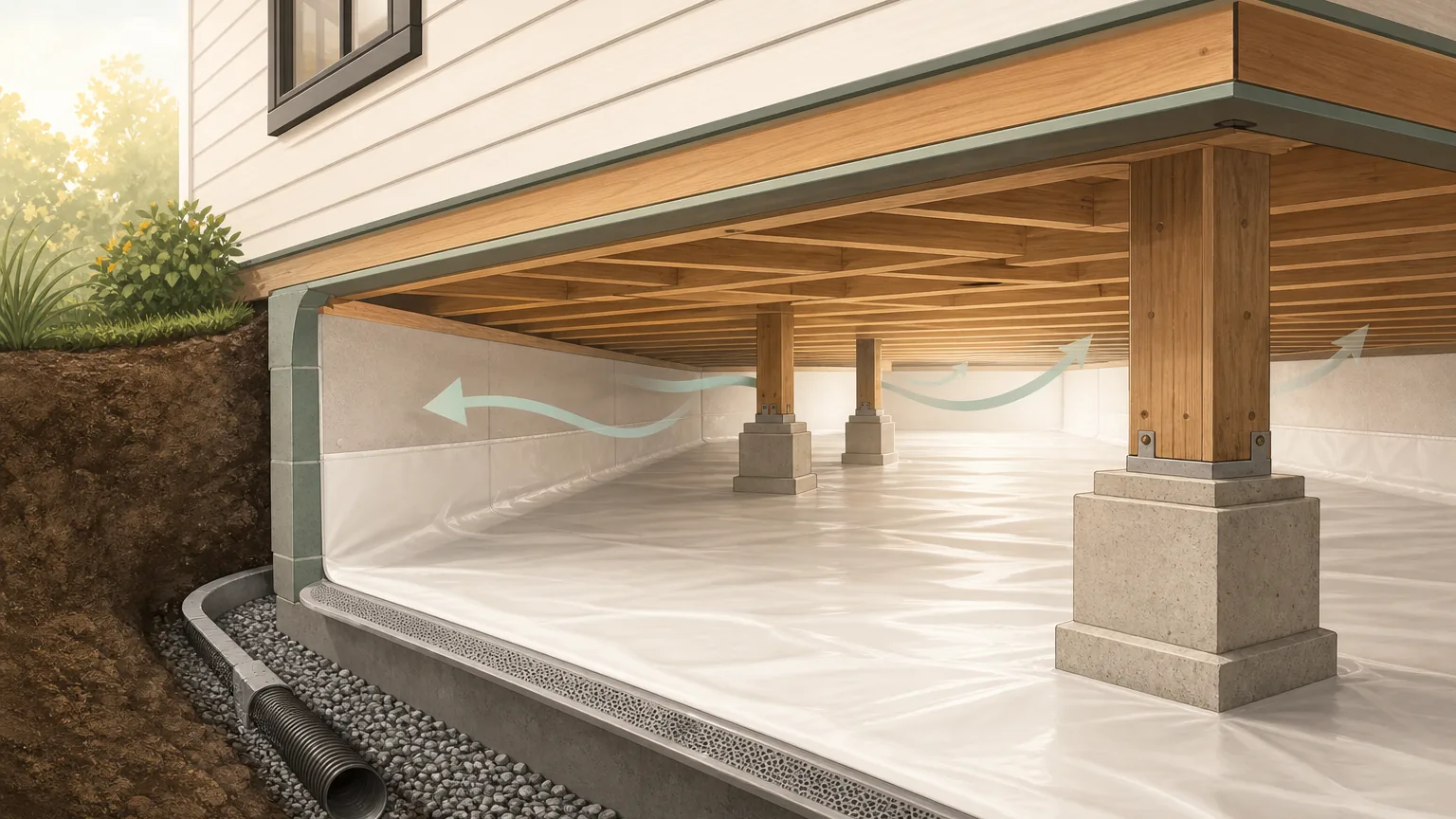
Encapsulation may include ground and wall liner, sealed seams and penetrations, vent and access-door treatment, drainage prerequisites, insulation decisions, and an approved moisture-control method. The exact design should identify every surface, mechanical detail, permit, monitoring point, and maintenance requirement.
This is different from a simple vapor barrier replacement. Full encapsulation commonly runs $5,000 to $15,000, versus roughly $1,000 to $4,000 for a basic vapor barrier, because it covers more surface area, uses heavier materials, and may require adjustments to the existing ventilation system. See the cost guide for scope-by-scope ranges. Getting a clear explanation of what is included and what is not can help you compare options side by side.
Questions to ask before moving forward
- What is the current condition of the vapor barrier, insulation, and wooden supports?
- Has water been standing in the crawl space, and if so, how often?
- Will closing the existing vents affect how the home performs seasonally?
- Will the quote separate material costs, labor, and any optional upgrades?
- Is there a warranty or service plan after the encapsulation is complete?
- Who obtains permits and handles building, mechanical, and electrical inspections?
- How will termite visibility, combustion safety, condensate, radon testing, and future service access be handled?
Budget for ownership, not only installation
Include equipment electricity, filters, condensate service, sump and alarm testing, backup batteries, drain cleaning, liner repairs, pest inspections, monitoring, and warranty service. Compare the cost guide and maintenance guide.
What a Gastonia provider can check during the visit
A local crawl space provider serving Gastonia and nearby communities can assess the layout, take moisture readings, identify any active water sources, and review the current ventilation setup before recommending encapsulation or a more targeted repair. That visit can also help you understand whether simpler fixes like improved drainage, vapor barrier coverage, or insulation removal might solve the problem first.
Related help: crawl space encapsulation, moisture control, vapor barrier installation, and drainage and standing water.
Helpful homeowner guidance
Use a source-first decision
Closed crawl spaces require water, mechanical, liner, insulation, humidity, permit, and maintenance decisions.
- Under North Carolina’s cited pathway, changing an existing conventionally vented crawl space into closed construction requires a permit.
- The Department of Energy guide evaluates safety, exterior water, interior water, pests, mechanical systems, liner, insulation, air sealing, and monitoring.
- NC State Extension recommends measuring humidity and checking leaks, sump operation, ground coverage, gutters, downspouts, and grade.
Sources: NC closed crawl-space permit interpretation, Department of Energy crawl-space guide, NC State Extension mold and moisture checklist
Disclosure: Gastonia Crawl Space Repair Help is an independent service that helps connect homeowners with local crawl space professionals. We do not perform contractor services ourselves. Your request may be shared with a local provider who can assist with your project.
Ask about encapsulation for your Gastonia home
Encapsulation decision questions
What should I fix before encapsulation?
Address active plumbing and condensate leaks, recurring stormwater, drainage, standing water, unsafe wiring, combustion concerns, pests, debris, damaged materials, and structural problems before closing the crawl space.
What simpler options might fit?
A targeted plumbing repair, gutter or grading correction, drainage repair, vapor-barrier repair, insulation removal, or monitored humidity plan may fit when the source and scope are limited.
What measurements help the decision?
Use water timing, humidity and temperature trends, liner and insulation condition, drainage and pump history, affected materials, pest evidence, and room-by-room floor symptoms.
What long-term costs should I consider?
Consider equipment electricity, filters, condensate and drain service, sump and alarm testing, backup batteries, liner repairs, pest inspections, monitoring, and any required annual service.
Does closing an existing vented crawl space require a permit?
The cited North Carolina code pathway requires a permit before a conventionally vented crawl space changes to a closed one, as explained by the Office of State Fire Marshal. Verify today’s Gaston County requirements.