Local crawl space service
Crawl Space Repair Near Me in Gastonia, NC
Request local help for standing water, musty odor, wet insulation, damaged vapor barriers, wood concerns, or soft and sagging floors.
Disclosure: Gastonia Crawl Space Repair Help is an independent service that helps connect homeowners with local crawl space professionals. We do not perform contractor services ourselves. Your request may be shared with a local provider who can assist with your project.
Homeowner request path
Gastonia, NC- Share the crawl space issue you are seeing.
- Choose repair, encapsulation, moisture, drainage, or support help.
- Get connected with a local provider when available.
Quick answer: Crawl space repair starts with finding the water source, then fixing the problem in order: drainage first, sealing after. Most full projects run $3,000 to $15,000 depending on scope. Share your Gastonia property location, the symptoms you see, and whether they change after rain to request local contact.
What homeowners usually notice first
Crawl space trouble often shows up inside the home before anyone looks under it. Floors may feel soft, rooms may smell musty, indoor humidity may stay high, or a pest problem may keep returning.
- Standing water or damp soil under the home
- Musty smells coming through floors or vents
- Sagging, soft, or uneven floors
- Mold concerns or visible wood rot
- High indoor humidity or pest activity
Crawl space repair in Gastonia, NC starts with diagnosis
Gastonia crawl space repair should identify the cause before quoting a fix. Water after rain, failed vapor barrier material, damp insulation, odor, wood decay, and sagging floors can point to different scopes. A good estimate should separate repair, prevention, and optional upgrades.
Common repair needs
Crawl space repair can involve drainage corrections, vapor barriers, insulation removal, joist or beam support, mold-related cleanup, and moisture control planning. The right scope depends on what is causing the problem under the home.
Structural repair: Sistering bolts or fastens a new joist alongside a locally rotted, cracked, or sagging joist so the two share the load. A beam with localized damage may be reinforced or supported with added posts; widespread rot or failure may require full replacement. Adjustable steel support jacks, also called screw jacks or telescoping posts, are set on new concrete footings poured beneath a beam or girder. Sagging framing is lifted gradually, then shimmed and locked off, with new piers or footings added where support is missing.
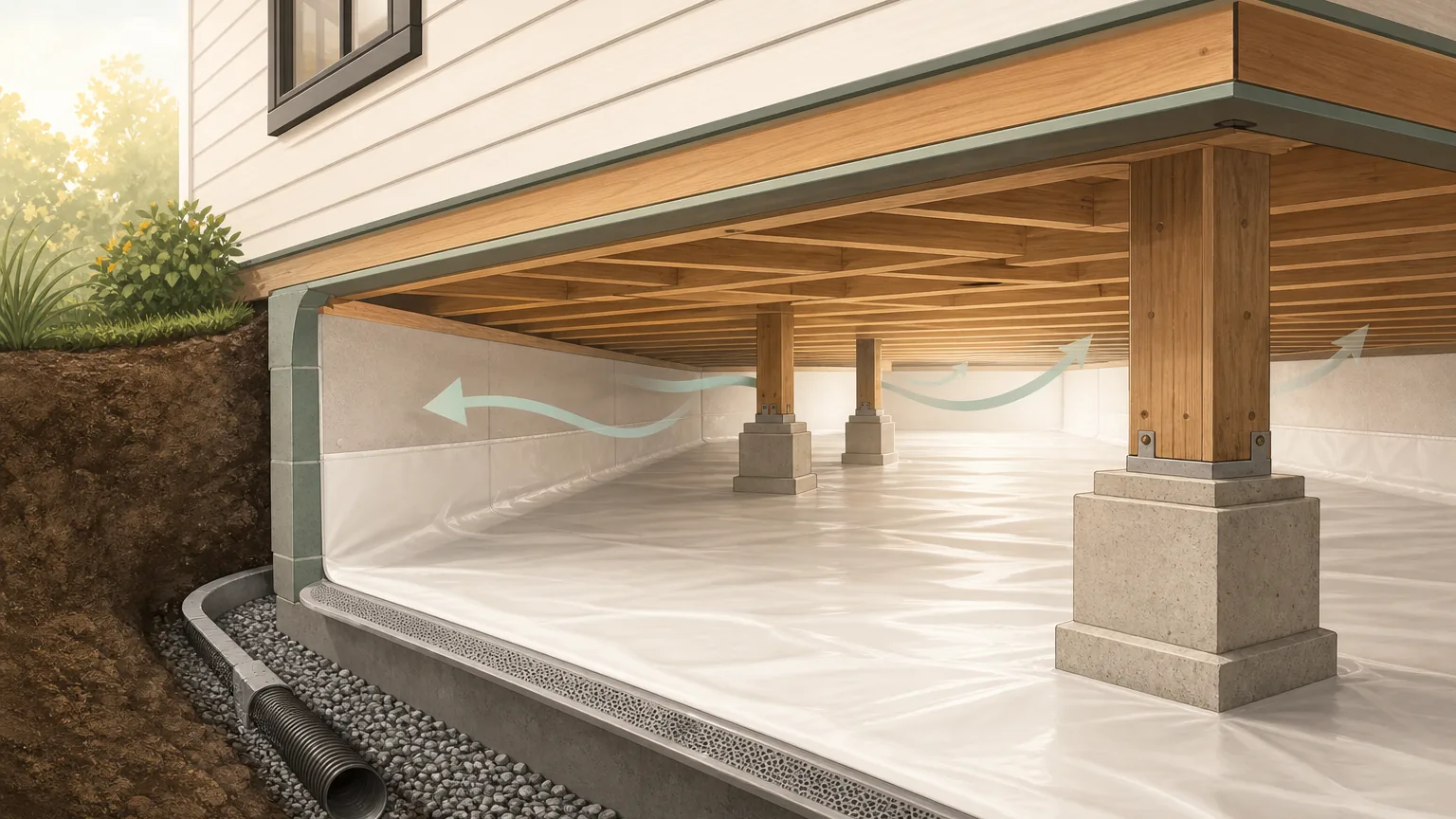
Drainage repair: An interior perimeter drain uses perforated pipe laid in a gravel-filled trench around the inside edge of the crawl space. The pipe is sloped to collect water that enters or rises through the ground and feeds a sump basin at the low point. A sump pump lifts the collected water, and a discharge line carries it well away from the foundation to daylight or an approved storm outlet instead of dumping it at the wall. A passive drain to daylight can work on a sloped lot; a high water table or standing water after rain usually needs an active sump.
How a useful inspection narrows the repair
- Check immediate hazards. Standing water near wiring, sewage, fuel-burning equipment, severe pest contamination, and visibly unstable framing change who should enter first.
- Trace exterior water. Review roof runoff, gutters, downspouts, grading, sprinklers, foundation entry, low areas, and existing discharge outlets.
- Trace interior water. Look for plumbing leaks, heating and cooling condensate, sump or drain failures, groundwater, and recurring storm entry.
- Measure moisture conditions. Record relative humidity, ground coverage, condensation, insulation condition, and visible wood moisture or staining.
- Map structural symptoms. Identify which floors, joists, beams, piers, footings, or connections show movement or damage before selecting a support method.
When the issue needs urgent attention
Ask for help quickly when there is standing water, wet electrical areas, soft or sinking floors, visible wood decay, strong odors, or insulation that stays damp. These problems can spread if moisture keeps feeding them.
How the main repair options differ
Moisture control addresses damp soil, humidity, and condensation. Drainage collects and discharges standing water. Encapsulation seals ground and wall moisture after bulk-water problems are handled. Insulation removal clears wet, fallen, pest-damaged, or odor-holding material before the new assembly is chosen.
What affects cost
Most full projects fall around $3,000 to $15,000, or about $3 to $10 per square foot. A basic ground-cover vapor barrier may run $1,000 to $4,000. Full encapsulation commonly runs $5,000 to $15,000. Interior perimeter drainage adds about $2,000 to $8,000, an installed sump pump runs about $600 to $2,500, and a crawl-space dehumidifier runs about $1,000 to $3,000. A contained joist or beam repair may run $1,000 to $4,000, while broader structural work commonly reaches $4,000 to $12,000 and severe replacement can exceed $20,000.
Square footage multiplies liner and labor quantities. Standing water creates a separate drainage line before sealing. Tight access slows removal and structural work. Thicker reinforced liner, such as 20-mil material instead of basic 6-mil polyethylene, costs more, better resists punctures, and normally lasts longer under service traffic. Wet insulation removal adds about $0.75 to $2 per square foot before replacement.
Gastonia's Piedmont red clay can move water slowly and stay wet after heavy rain, so a $2,000 to $8,000 drainage scope may need to come before a $5,000 to $15,000 encapsulation. Humid North Carolina summers make a $1,000 to $3,000 dehumidifier more relevant here than in a dry climate. Recurring standing water after storms points toward drainage and a $600 to $2,500 sump system rather than ground cover alone. See the full crawl-space repair cost guide for source-backed scope ranges and quote-comparison details.
What a written scope should separate
Ask for source correction, cleanup, drainage, ground-cover or vapor barrier work, humidity equipment, insulation, electrical work, permits, and structural work to appear as separate line items. The estimate should also name excluded work, the change-order process, maintenance, warranty limits, and the final checks used to confirm the repair.
When another specialist may belong in the plan
A plumber may need to stop an active supply or drain leak. An electrician should address wet or unsafe wiring. A pest professional may need to evaluate termites or animal contamination. A structural engineer may help when movement is significant or the repair design is unclear. A qualified remediation professional may be appropriate for extensive growth, contaminated water, or heating and cooling contamination.
How to verify the work afterward
- Photograph the repaired source and the completed work from the same locations used during the inspection.
- Test sump pumps, alarms, drains, and discharge paths where those systems are included.
- Record crawl-space humidity after the system has had time to operate.
- Confirm condensate and pumped water terminate at the stated outlet.
- Keep the permit, inspection record, equipment manuals, maintenance schedule, and written warranty.
What to ask before hiring a provider
- What is causing the problem under the home?
- Which items are repair, which items are prevention, and which items are optional upgrades?
- Can you show photos of the crawl space findings?
- Will the quote separate drainage, insulation, vapor barrier, encapsulation, and structural support items?
Related pages: mold and musty odor concerns, crawl space waterproofing for bulk-water entry and removal, drainage and standing water, vapor barrier help, insulation removal, sagging floor repair, and cost factors.
Disclosure: Gastonia Crawl Space Repair Help is an independent service that helps connect homeowners with local crawl space professionals. We do not perform contractor services ourselves. Your request may be shared with a local provider who can assist with your project.
Request crawl space repair help
Use this form for crawl space repair in Gastonia when you see soft floors, standing water, musty odor, wet insulation, damaged vapor barrier material, or moisture damage under the home.
Repair questions
What should a crawl space repair inspection include?
The inspection should document exterior drainage, active leaks, standing water, ground cover, humidity, insulation, visible wood conditions, floor-support components, pests, access, and heating or cooling equipment before recommending a repair scope.
Does every damp crawl space need encapsulation?
No single system fits every source. Active plumbing leaks, stormwater, groundwater, failed drainage, damaged framing, pests, or contaminated materials may need attention before a sealing plan is considered.
When might a structural engineer be useful?
An engineer may be useful when the cause or repair design is uncertain, movement is significant, several supports are involved, framing has been altered, or the proposed work affects how loads move through the home. Ask the applicable permit authority and provider who should design the scope.
How should I compare crawl space repair estimates?
Compare the documented cause, required preparation, repair method, materials, drainage and discharge work, electrical or permit needs, exclusions, change-order terms, completion checks, maintenance, and warranty language. A $6,000 liner proposal that excludes $2,000 to $8,000 of drainage is different from a $12,000 proposal that includes it.
How much does crawl space repair cost in Gastonia?
Most full projects run $3,000 to $15,000, or about $3 to $10 per square foot. A basic vapor barrier job may be $1,000 to $3,000, while full encapsulation with drainage and structural work can reach $20,000 or more. The final number depends on crawl space size, water source, access, and whether structural repairs are needed.
What information should I send with a repair request?
Share when the symptom started, its location, whether it changes after rain, any humidity readings, plumbing history, affected rooms, access limits, and photos taken from a safe location. A provider may request the actual photos after making contact.
See crawl space repair cost factors or compare encapsulation help.