Repair
Repair can include damaged wood, support concerns, access fixes, cleanup, and other problem-specific work.
Local cost guide
A useful estimate separates active water and drainage from insulation, vapor barrier, wood or floor-support repair, and optional encapsulation work.
Disclosure: Gastonia Crawl Space Repair Help is an independent service that helps connect homeowners with local crawl space professionals. We do not perform contractor services ourselves. Your request may be shared with a local provider who can assist with your project.
Homeowner request path
Gastonia, NCQuick answer: Current national cost guides put many full crawl-space projects around $3,000 to $15,000, or roughly $3 to $10 per square foot. A contained repair may start near $1,500. A combined project with extensive drainage, encapsulation, and structural work can reach $20,000 to $40,000 or more. These are planning ranges rather than a Gastonia quote. If water keeps coming back or appears after rain, start with drainage and standing water guidance; if you need repair help, use crawl space repair in Gastonia. Send the water history, access details, floor or insulation symptoms, and a description of any safe-location photos through the Gastonia request page. A provider may request the actual images after contact.
Angi reports $4,500 to $8,000 for many crawl-space repair projects and $5,000 to $15,000 for professional encapsulation. HomeGuide separates wet crawl-space repair at $1,500 to $5,000 from encapsulation at $3,000 to $15,000 or $3 to $10 per square foot. Its crawl-space mold-remediation guidance gives $1,500 to $4,000 as the average range. This Old House reports $1,500 to $15,000 for encapsulation, with basic work at $3 to $7 per square foot and extensive moisture work reaching $10 per square foot. Your price depends on the diagnosed scope, and combined systems can exceed any one category's range.
The first clue may be a musty smell, soft floor, visible water, high indoor humidity, or insulation hanging down under the house. Those symptoms matter because each one points to a different cost bucket.
Repair can include damaged wood, support concerns, access fixes, cleanup, and other problem-specific work.
Drainage focuses on standing water, wet soil, and how water moves around or under the home.
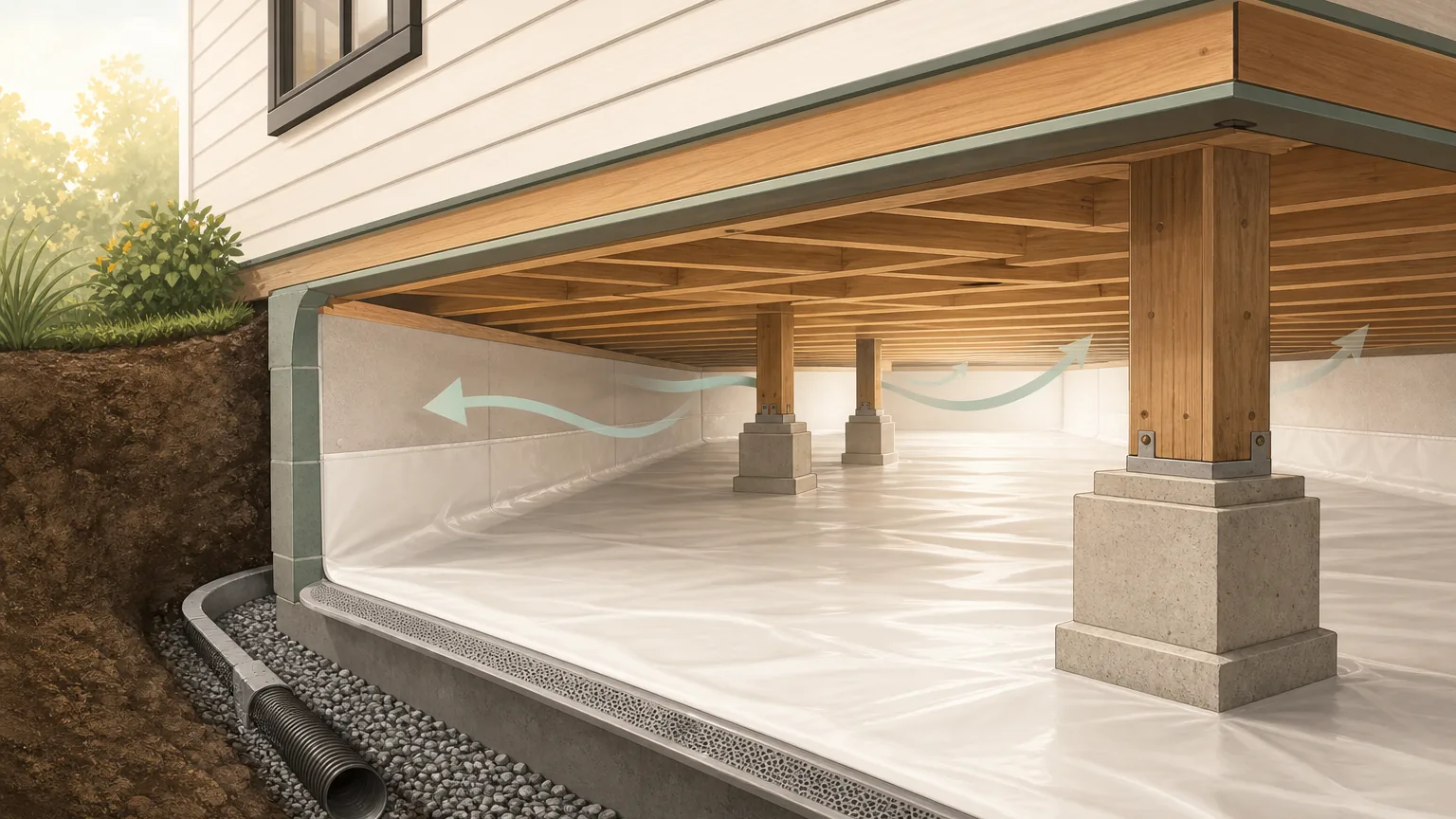
Encapsulation usually adds sealed ground coverage and moisture-control measures after the crawl space is ready.
Insulation removal may be needed when old material is wet, dirty, fallen, pest-damaged, or holding odor.
Piedmont red clay moves water slowly and can stay wet for long periods, especially where construction has compacted soil near the foundation. That makes the $2,000 to $8,000 drainage line relevant before a $5,000 to $15,000 encapsulation. Humid North Carolina summers also make a $1,000 to $3,000 dehumidifier more relevant than it would be in a dry climate. After heavy rain, a rising local water table and recurring standing water point toward drainage and a $600 to $2,500 sump system rather than a $1,200 to $4,000 ground cover alone.
A $5,000 liner proposal can become a $10,000 to $20,000 project when it excludes $2,000 to $8,000 of drainage, a $1,000 to $3,000 dehumidifier, or structural work that starts around $1,000 and can exceed $20,000. Ask which of these lines are inside the total:
Use $3,000 to $15,000 only as a planning range until the source is known. A clearer request helps distinguish a $1,200 to $4,000 ground-cover job from $2,000 to $8,000 of drainage or structural work that may exceed $20,000. Include the crawl-space access location, whether water appears after rain, the condition of the vapor barrier, whether insulation is wet or fallen, and whether floors above feel soft or uneven.
If the problem feels urgent after heavy rain, start with crawl space water after heavy rain. If you are still identifying symptoms, review crawl space moisture damage signs.
A local provider needs to see the crawl space before deciding whether the scope is closer to a $1,200 to $4,000 vapor barrier, $2,000 to $8,000 drainage system, or structural repair that starts near $1,000 and can exceed $20,000. Photos help, but moisture sources and structural concerns often require an on-site look.
Place each estimate in a column and compare the diagnosed source, measurements and photos, required preparation, material or equipment model, quantities, outlet location, permits, start and completion assumptions, exclusions, maintenance, warranty, and total. A $6,000 encapsulation estimate that excludes $2,000 to $8,000 of drainage is not directly comparable with a $12,000 proposal that includes it. Ask each provider to revise unclear language in writing before choosing.
For service details, visit crawl space repair in Gastonia, crawl space encapsulation, crawl space waterproofing, mold and odor concerns, drainage and standing water, or vapor barrier help.
Helpful homeowner guidance
Published averages combine very different problems. Consumer protection guidance and an itemized scope provide a safer basis for comparing Gastonia estimates.
Sources: Angi crawl-space repair cost guide, Angi encapsulation cost guide, HomeGuide crawl-space repair and cleaning cost guide, HomeGuide crawl-space encapsulation cost guide, HomeGuide drainage-system cost guide, HomeGuide crawl-space dehumidifier cost guide, HomeGuide crawl-space insulation cost guide, Angi floor-joist repair cost guide, This Old House encapsulation cost guide, NC Department of Justice housing guidance
Disclosure: Gastonia Crawl Space Repair Help is an independent service that helps connect homeowners with local crawl space professionals. We do not perform contractor services ourselves. Your request may be shared with a local provider who can assist with your project.
Most full projects run $3,000 to $15,000, or about $3 to $10 per square foot. A basic vapor barrier job may be $1,000 to $3,000, while full encapsulation with drainage and structural work can reach $20,000 or more. The final number depends on crawl space size, water source, access, and whether structural repairs are needed.
One provider may quote a $1,200 to $4,000 ground cover while another includes $2,000 to $8,000 of drainage, a $1,000 to $3,000 dehumidifier, or structural work that can exceed $20,000. Compare diagnosed sources, line items, materials, preparation, and exclusions before comparing totals.
HomeGuide estimates that running a crawl-space dehumidifier can add about $10 to $30 per month and that sump-pump maintenance plans can run $100 to $250 per year. Also ask about filters, alarms, backup batteries, drain cleaning, liner repairs, pest inspections, and any annual service plan.
Hidden rot can move a $1,000 to $4,000 contained structural repair toward $4,000 to $12,000 or more. Inaccessible areas, contaminated materials, failed drains, electrical needs, permit requirements, and a newly identified water source can also add work. The contract should require documentation and approval before added work begins.
The North Carolina Department of Justice recommends comparing three written estimates for home repair work. Each estimate should describe the same requested scope so the comparison stays meaningful.